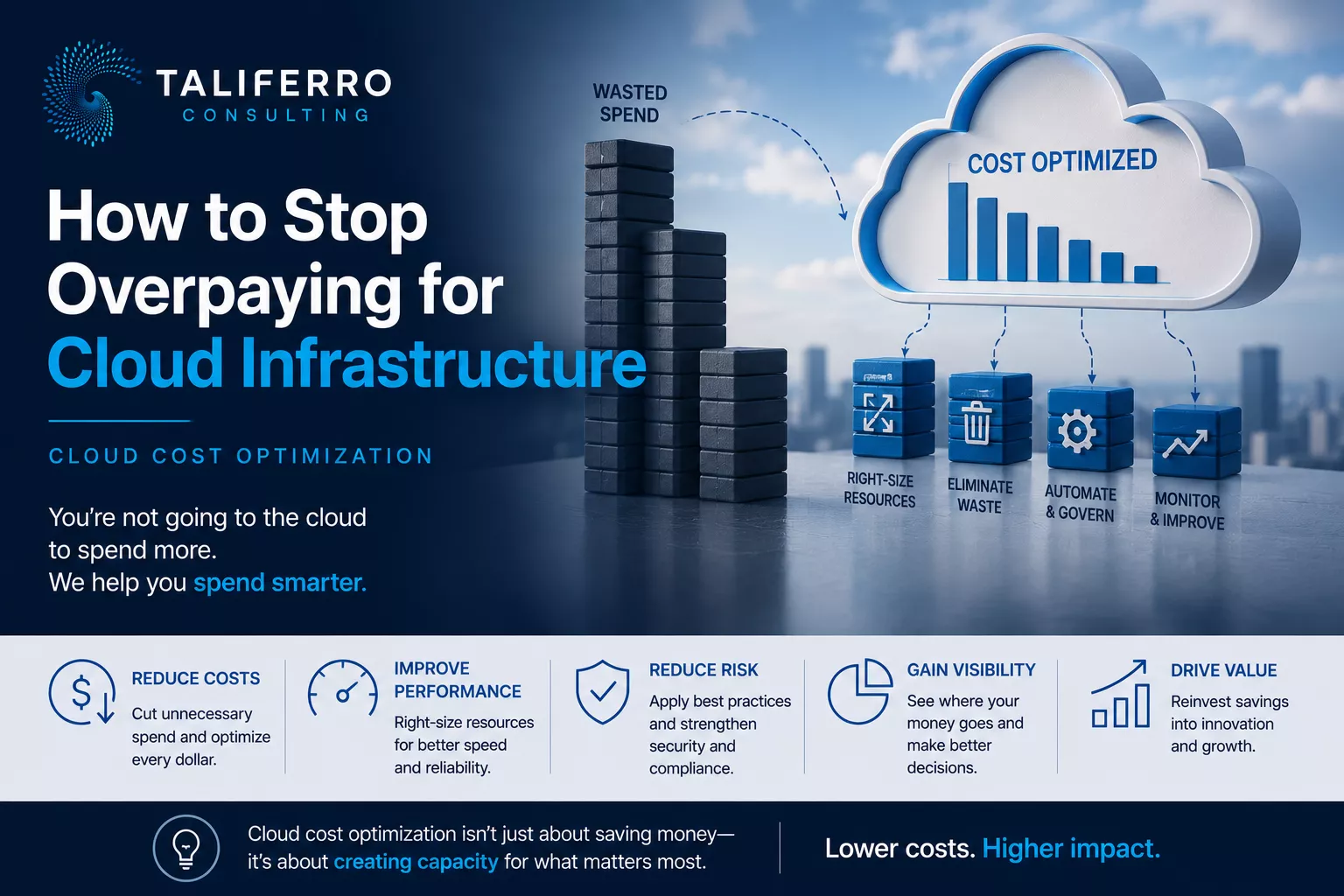
Cloud overspending isn't a cloud problem. It's a governance problem. Nobody owns cost visibility, nobody's enforcing policies, and every team optimizes for convenience while someone else pays the bill. This is fixable — fast.
Intake within 24 hours. Written delivery within 3 days. No retainer. No contract.
Where the money is going
Why cloud governance is so hard
Cloud makes provisioning fast and visible, but cost tracking slow and invisible. By the time a team sees its bill, the waste has already been running for 30 days. Without a forcing function — showback, tagging, auto-shutdown — the default behavior is to overspend.
Cloud providers have no financial incentive to make waste easy to see. Their job is to make spinning up resources frictionless. Your job is to make accountability equally frictionless.
A $200K FinOps platform doesn't fix a $50K governance problem. Start with the right policies, not the biggest tool.
Your deliverables
How it works
Bring your last cloud bill and a rough description of your environment. That's usually enough to identify the biggest opportunities.
Why are cloud costs always higher than projected?
Because cloud makes it easy to spin up resources and hard to track who owns them. Without cost tagging, showback, and auto-shutdown policies, every team optimizes for convenience and someone else pays the bill. Cloud pricing is also deliberately complex — the incentive structure favors the vendor.
What percentage of cloud spend is typically wasted?
Industry data consistently shows 30–35% of cloud spend is waste — idle instances, oversized resources, orphaned storage, and dev environments that run continuously at production scale. Almost every environment we've reviewed has immediate, low-risk cuts available before any architectural changes.
How quickly can cloud costs be reduced?
Quick wins — rightsizing, turning off idle resources, eliminating orphaned storage — can be executed in 1–2 weeks and typically yield 15–25% reduction immediately. Structural changes like reserved instances and architecture optimization take longer but produce larger sustained savings.
Do we need a dedicated FinOps team?
Only if cloud spend is over $5M per year. Below that, the problem is usually governance and tagging, not a dedicated team. Start with clear ownership and the right guardrails — that's usually enough. A FinOps team without governance infrastructure just creates an expensive reporting function.
IT Spending & Speed
Why are we spending millions on IT and still moving slow?
Cloud waste is part of a bigger pattern →
Legacy Systems
Should we rebuild or patch legacy systems?
Legacy on cloud = expensive architecture →
Headcount & Output
Do we need all these people?
Team structure drives infrastructure decisions →
No platform pitch. No $200K FinOps tool recommendation. A focused cost audit that identifies exactly where your cloud spend is going and gives you a concrete, risk-ordered plan to reduce it.
Not sure this is the right fit? See all rescue services →