Taliferro
All Rescue Services Contact
CTO · AI & Engineering

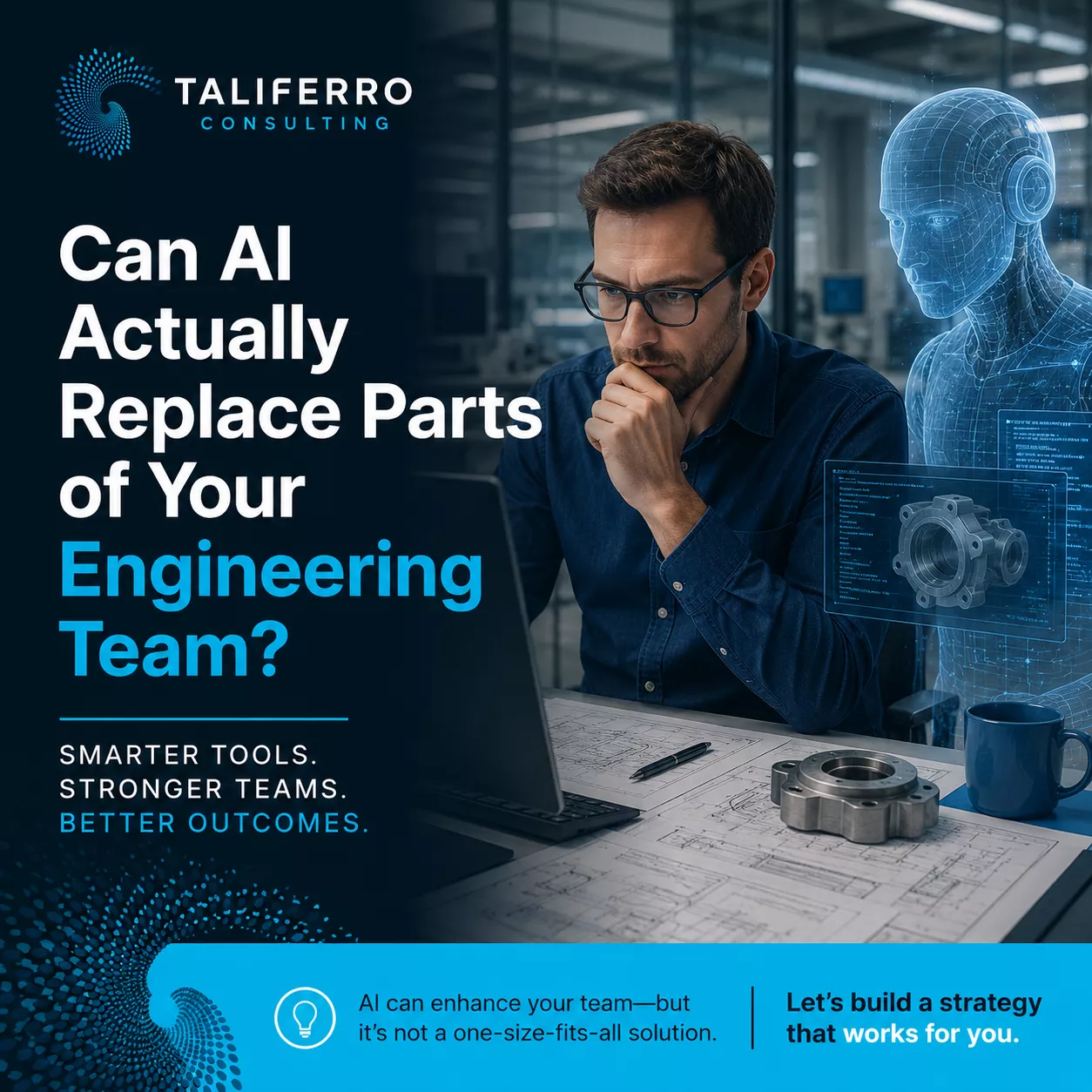
Can AI Actually Replace Parts of Your Engineering Team?

The board read an article about developers being replaced by AI. Now they're asking questions you need honest answers to — not vendor talking points and not reflexive dismissal. What's actually automatable, what's the real productivity gain, and what are the risks your legal and security teams haven't asked about yet?

$999 flat  ·  results in 3 days

Intake within 24 hours. Written delivery within 3 days. No retainer. No contract.

CTO evaluating AI tools and their impact on the engineering team and software development workflow
The real picture

The Hype Is Real. So Is the Risk. Here's How to Tell Which Is Which.

What AI genuinely does well in engineering

  • Boilerplate code generation that used to take hours now takes minutes — and the quality is measurably better for standard patterns
  • Unit test scaffolding: AI generates tests for repetitive scenarios faster than any developer wants to write them
  • Code review assistance catches common patterns, naming inconsistencies, and obvious bugs before human review
  • Documentation generation from existing code is dramatically faster with AI than without it
  • Bug localization — describing a problem and getting a likely location — is genuinely useful and speeds triage

What AI does badly — and the risks nobody's talking about

  • AI-generated code has subtle security vulnerabilities that pass visual review but fail a security audit — and the model doesn't flag them
  • Complex business logic requires context the model doesn't have — the output looks right and is wrong in specific edge cases
  • Enterprise code sent to external AI models may train the next version of that model — your IP is the training data
  • Teams that trust AI output without review create a false sense of velocity — bugs ship faster, not slower
The rescue

A Practical Assessment of What AI Can and Can't Do in Your Engineering Context.

Your deliverables

  • A map of your engineering workflow with AI-ready tasks identified versus tasks that require human judgment
  • A security and IP risk assessment for your specific AI tool usage — what exposure you currently have and don't know about
  • A productivity measurement framework so you can quantify AI gains in terms your CFO will understand
  • A written summary you can use with the board and with your engineering team — honest on both the upside and the risk

How it works

  1. Pay $999 to secure the slot.
  2. Intake within 24 hours — a short email asking exactly what I need.
  3. Delivery within 3 days — a written output you can act on immediately.

Bring your current engineering workflow and the AI tools you're already using or evaluating. That's enough to start.

FAQ

What CTOs Actually Ask About AI and Engineering Teams.

Which engineering tasks can AI safely automate today?

Boilerplate code generation, unit test scaffolding, code review suggestions, documentation generation, and bug localization are genuinely mature. AI for architecture decisions, security-sensitive code, and complex business logic requires significant human oversight. The line isn't "AI vs. humans" — it's supervised versus unsupervised AI.

How much can AI tools reduce software development costs?

Credible benchmarks show 20–35% productivity improvement in code generation tasks for experienced developers. For a 20-person engineering team, that's meaningful — but it typically shows up as faster delivery, not fewer engineers. Teams that try to capture the savings as headcount reduction often find that coordination overhead absorbs the freed capacity.

What are the security risks of AI-assisted coding?

The main risks: IP leakage if code is sent to external models that use it for training, AI generating code with subtle security vulnerabilities it doesn't flag, and developers trusting AI-generated code without security review. Enterprise plans for most AI tools address risk 1. Risks 2 and 3 require process controls, not just tool selection.

Should we reduce headcount because of AI?

Not as a first move. Most teams that try to cut headcount based on AI productivity projections find that the savings disappear into coordination overhead and quality rework. The better play: let AI handle repetitive tasks while engineers focus on higher-leverage work — and measure throughput, not headcount.

Related problems

AI in Engineering Doesn't Exist in Isolation.

$999 flat  ·  intake within 24 hours  ·  delivery in 3 days

No vendor demos. No hype. An honest, specific assessment of what AI can and can't do in your engineering workflow — with a productivity framework your CFO can read and a risk summary your security team can act on.

Not sure this is the right fit? See all rescue services →